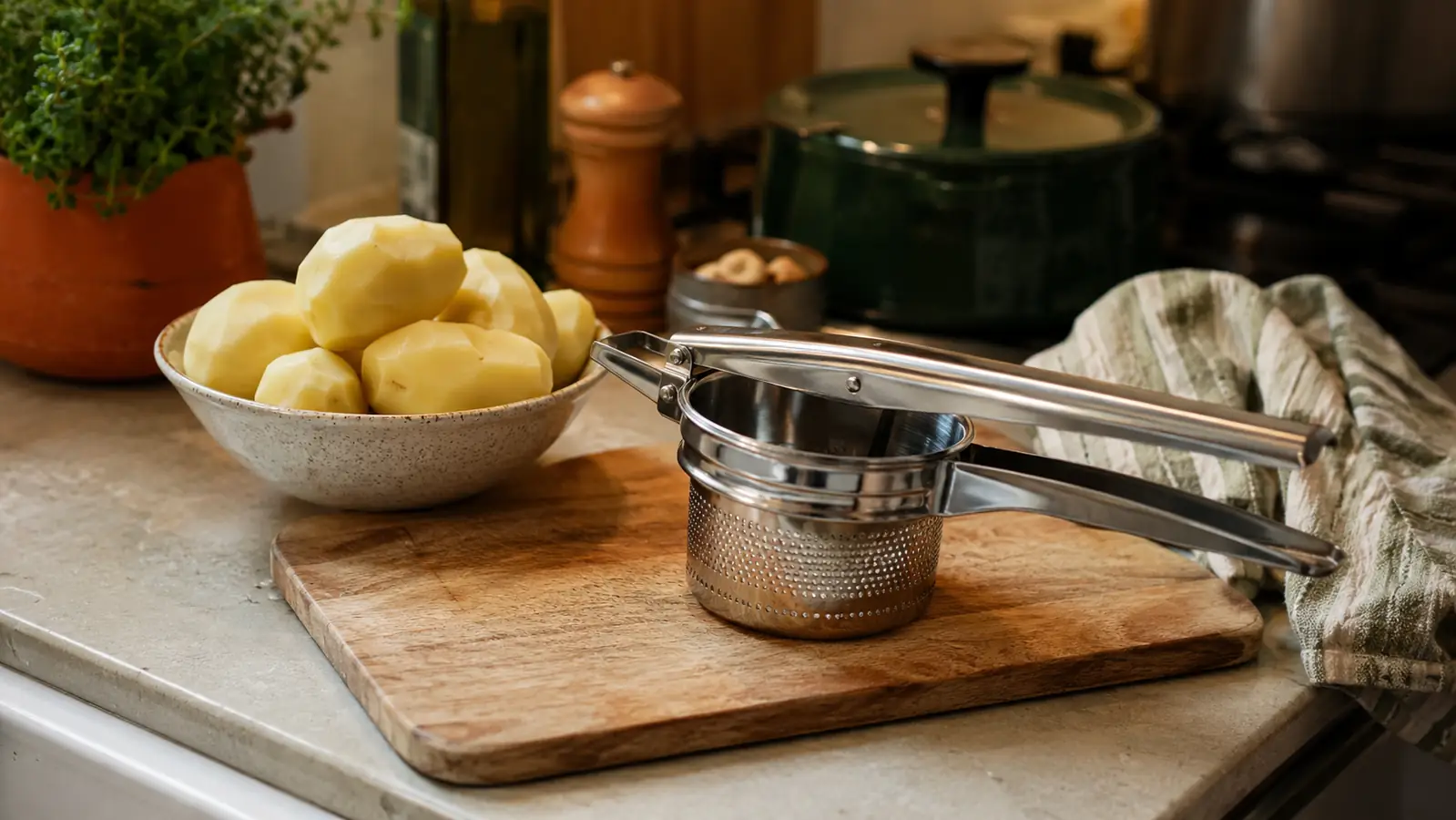
Every review of this ricer says basically the same three things: no lumps, easy cleanup, worth the money. All true. None of it is the whole story. I bought the PriorityChef potato ricer last October after burning out a hand masher on a five-pound bag of Yukon Golds, and I've used it close to every week since, for regular dinners, not just holiday showpieces. What follows is what I wish someone had told me before I clicked buy, the parts that don't fit neatly into a five-star headline.
This isn't a takedown. I still reach for it over a masher most weeks. But if you're picturing effortless, magazine-photo mashed potatoes with zero tradeoffs, I want to walk you through the actual experience first, discs, grip strain, drawer space, all of it.
I should say upfront where I'm coming from. I'm not a professional tester and I don't get free products to review, I bought this ricer with my own money at a regular retail price after reading through probably forty reviews and still walking away with unanswered questions. Those unanswered questions are exactly what I'm answering here, the stuff that only shows up after you've used something enough times that the honeymoon period wears off.
The Quick Verdict
Genuinely lump-free potatoes with almost no learning curve, but it takes real forearm strength and a specific kind of kitchen storage commitment that the glowing reviews gloss over.
Amazon Check Today's Price →See today's price and current stock on Amazon
Before I get into the fine print, here's where to find the exact model I've been using, the 15oz stainless PriorityChef ricer with the three interchangeable discs.
Amazon Check Today's Price on Amazon →How I've Actually Used This Ricer
I cook dinner most nights for a family of four, and potatoes show up in some form at least twice a week, mashed, riced for gnocchi, or pressed for potato pancakes. I started using this ricer specifically because my old wire masher was leaving streaks of unmashed potato no matter how long I worked at it, and my husband, who grew up eating his grandmother's smooth, almost whipped mashed potatoes, kept noticing.
My routine now is simple. I boil peeled Yukon Golds or russets until a fork slides in with no resistance, drain them, let them sit in the colander for two or three minutes to steam off excess moisture, then rice them straight into the pot I'll mix them in. I'm not weighing potatoes or timing anything precisely. This is a real weeknight tool, not a test kitchen setup.
What surprised me isn't that it works, every ricer on the market rices potatoes fine when the potato is properly cooked. What surprised me is how much the details matter, things nobody mentions in the reviews that convinced me to buy it in the first place.
I also want to be clear that I didn't switch cold turkey. For the first month, I kept my old masher in the drawer as backup, mostly out of habit, and used it maybe twice when I only had two potatoes to deal with and couldn't be bothered to pull the ricer out and wash the extra parts. That backup masher is long gone now, donated, because once I got past the initial disc-swapping fumble I genuinely reach for the ricer even for small batches. But it took a few weeks of side-by-side use before that became true, not one perfect first try.
The Discs Nobody Reads the Fine Print On
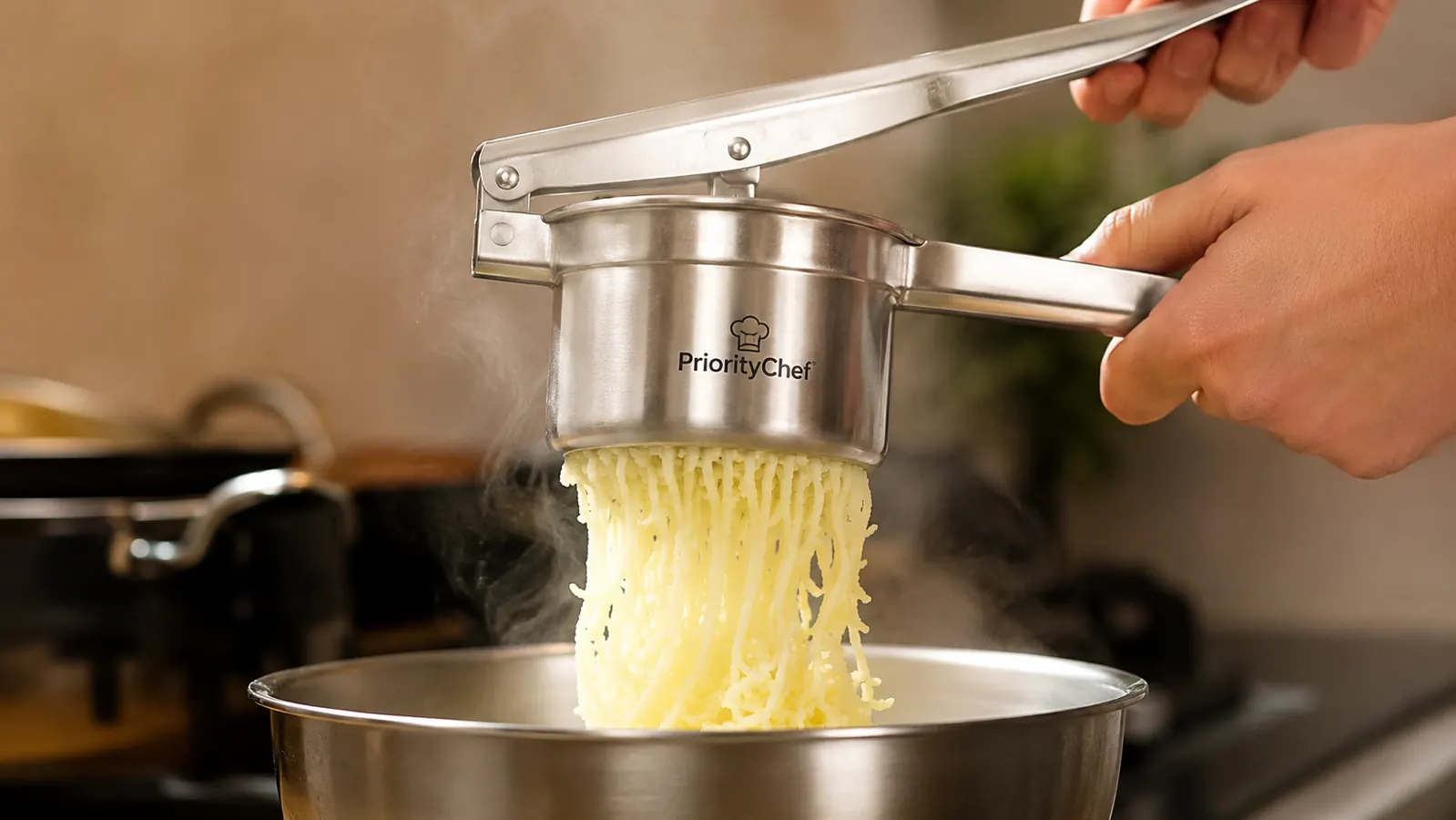
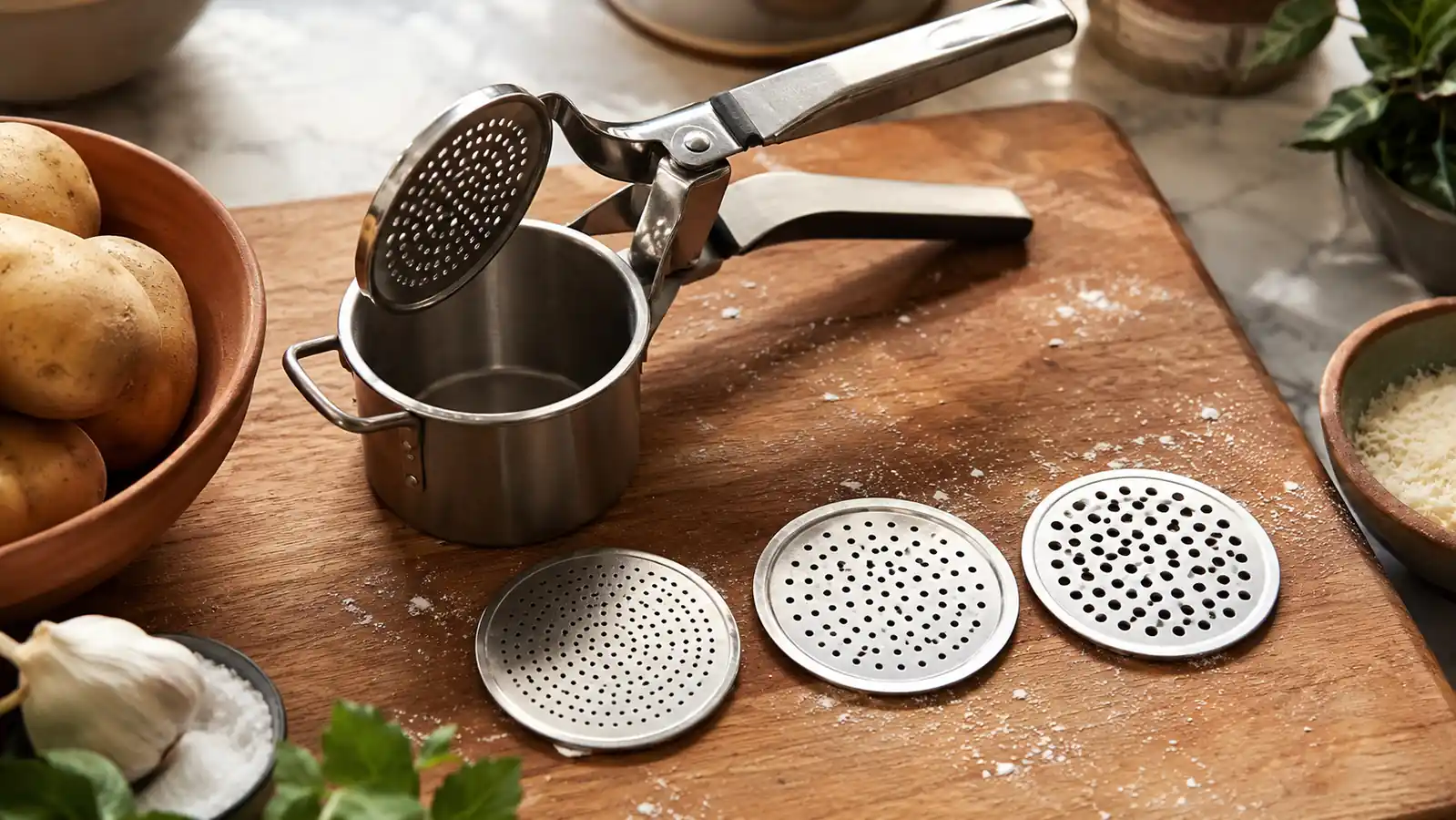
This ricer comes with three interchangeable discs, labeled roughly fine, medium, and coarse based on hole size. The fine disc is what most people picture when they think of riced potatoes, thin, delicate strands that mash into a smooth, almost pillowy texture. It's what I use for mashed potatoes ninety percent of the time.
Here's the part the five-star reviews skip. Swapping discs is not a thirty-second job the first few times you do it. The disc sits in a groove at the bottom of the hopper and has to seat exactly right or it pops loose mid-squeeze, dumping unriced potato back into the hopper and making a mess of the countertop. It took me three or four tries before I could swap discs without fumbling. Now it's second nature, maybe fifteen seconds, but the learning curve is real and nobody warns you about it.
The coarse disc is genuinely useful for gnocchi dough, where you want texture without gumminess, and the medium disc is my pick for potato pancakes when I want the shreds to hold together in the pan. If you're only ever making classic mashed potatoes, you'll use the fine disc almost exclusively and the other two will sit in a drawer. That's not a flaw, but it's worth knowing before you pay extra for a three-disc set you might only touch once a year.
The Hand Fatigue Problem
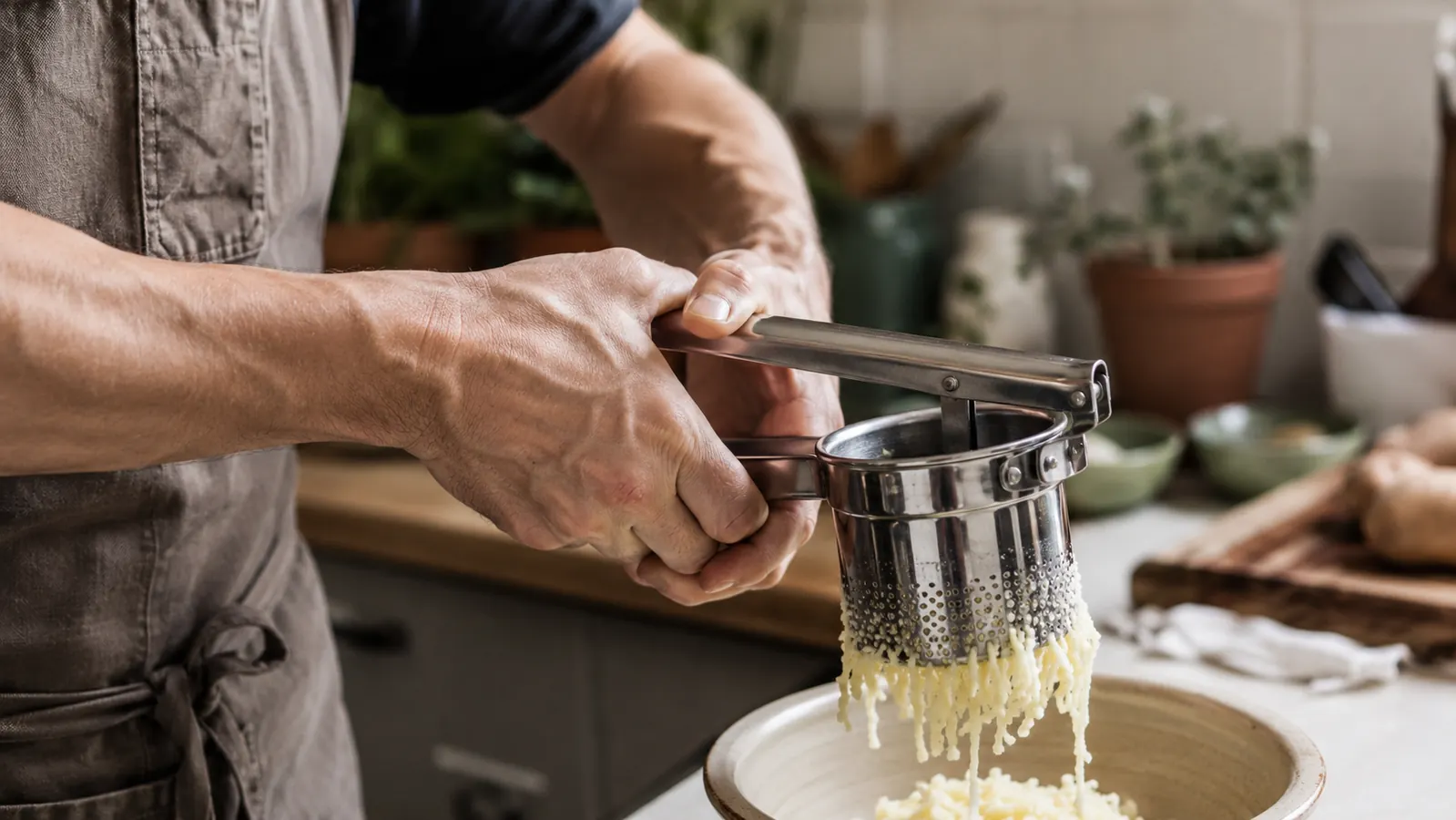
This is the one that actually surprised me. A hand masher works with a stomping, downward motion that uses your shoulder and body weight. A ricer works entirely off hand and forearm strength, you're closing two long levers against resistance, over and over, for every scoop of potato that goes into the hopper.
For a single serving of potatoes, that's nothing. For a full five-pound batch, which is what I make for Sunday dinners with my in-laws, I'm doing that squeeze motion fifteen to twenty times, loading the hopper each time. By the end, my forearm and the webbing between my thumb and index finger are noticeably tired. I have decent hand strength from years of cooking and gardening, and it still gets me. If you have arthritis, carpal tunnel, or any kind of grip weakness, I would genuinely think twice before assuming this is the easier option compared to a masher. It's less effort per stroke, but it asks a very specific muscle group to do repeated work that a masher spreads across your whole upper body.
The long handles do give you real leverage, which helps, and PriorityChef's handle diameter is comfortable enough that it doesn't dig into your palm the way some cheaper ricers do. But leverage isn't the same as effortless, and that distinction gets lost in a lot of the marketing around this style of tool.
The workaround I landed on, after complaining about it to a friend who happens to be a physical therapist, is to rice in smaller batches and take a short break between hopper loads rather than muscling through the whole five pounds in one continuous push. It adds maybe ninety seconds to the total prep time, but it makes a real difference in how my hand feels afterward. I also switched which hand I lead with halfway through a big batch, which sounds minor but genuinely helps distribute the strain instead of fatiguing one side.
What Happens After Six Months in a Drawer
The stainless steel body has held up exactly the way I'd expect from a well-made tool, no rust, no pitting, no loosening at the hinge even with weekly use. That part isn't a surprise, stainless is stainless. What did surprise me is how much space this thing actually takes up. The handles don't fold or collapse, so it occupies close to fifteen inches of drawer length whether it's clean, dirty, or sitting unused for a month. In my kitchen, that meant reorganizing a drawer specifically to fit it, which is a small thing, but it's not something the product photos prepare you for.
I run mine through the dishwasher most of the time, and PriorityChef markets it as dishwasher safe, which it is. But I've noticed the tiny holes in the fine disc are prone to trapping bits of dried potato if I don't rinse it right after use. Left overnight, that starch can dry into the holes and take real scrubbing with an old toothbrush to clear out. It's a two-minute annoyance, not a dealbreaker, but if you're the type who leaves dishes for morning, plan on soaking this one instead.
After roughly nine months of regular use, the only wear I can point to is a slight loosening in how snugly the disc seats, it takes a touch more attention now to get it locked in flush than it did in month one. It hasn't affected performance, but it's the kind of thing that makes me curious how it'll hold up at the two or three year mark.
One more thing worth mentioning, since it's the kind of detail that only shows up with time, the rubberized grip coating on the handles has started to show faint wear marks where my palm rests most, a slightly duller texture compared to the rest of the handle. It's cosmetic, not functional, the grip is still secure, but if you're someone who expects a kitchen tool to look brand new indefinitely, this one will show its use.
Where It Actually Beats a Hand Masher (and Where It Doesn't)
The texture difference is real and it's the whole reason to own this thing. A masher, no matter how long you work it, leaves you with a texture that ranges from chunky to gluey depending on how hard you push, because you're crushing cell walls unevenly. A ricer forces the potato through uniform holes exactly once, which is why the texture comes out consistent every time, light and fluffy rather than gluey or lumpy. If smooth, restaurant-style mashed potatoes are the goal, there's no real substitute.
Where the masher still wins, honestly, is speed and simplicity for small batches. If I'm making mashed potatoes for just my husband and me, two potatoes, one pot, the masher is faster because there's no hopper to load and reload. The ricer's advantage shows up specifically at volume, and specifically when texture matters more than speed. I've also found the ricer useless for chunky, rustic-style mashed potatoes with skin left on, the disc holes just aren't built for that job, and a masher or even a fork does it better.
The Cheaper Ricers I Tried First
Before I landed on this one, I actually went through two other ricers, a nine-dollar plastic model from a big-box store and a secondhand aluminum one I picked up from my mother-in-law's kitchen drawer when she upgraded her own setup. Neither survived more than a few months of regular use, and comparing them honestly is part of why I trust this review more than the average five-star blurb.
The plastic ricer cracked at the hinge after maybe six uses. It wasn't abuse, I was riding it exactly the way you're supposed to, and the plastic pivot point just couldn't take the repeated torque of squeezing against cooked potato resistance. It also flexed under pressure in a way that made the whole thing feel unstable, like it might snap mid-squeeze over a hot pot. I wouldn't recommend a plastic ricer to anyone who plans to use it more than a handful of times a year.
The aluminum hand-me-down held up structurally but the finish wore fast, small pockmarks and discoloration showed up within a couple months that never happened with the stainless PriorityChef model. Aluminum also reacts slightly with acidic ingredients over time, which showed up as a faint metallic taste when I riced potatoes for a vinegar-heavy potato salad. That's a narrow use case, but it's the kind of thing you don't think about until it happens to you. Stainless steel doesn't have that problem, and honestly that alone justified the price jump for me.
What I Liked
- Produces genuinely lump-free, restaurant-texture mashed potatoes every time
- Three interchangeable discs cover mashed potatoes, gnocchi dough, and potato pancakes
- Stainless steel body has shown zero rust or pitting after months of regular use
- Long handles give real mechanical leverage for large batches
Where It Falls Short
- Repeated squeezing fatigues the hand and forearm on big batches, more than a masher does
- Disc swapping has a real learning curve before it feels quick
- Fine disc holes trap dried starch if not rinsed promptly
- Takes up more drawer space than a folding masher, roughly 15 inches with no collapse option
- Not built for rustic, skin-on, chunky-style mashed potatoes
It's not that the ricer lies to you. It's that the five-star reviews only mention the twenty seconds where the potato comes out perfect, not the fifteen squeezes it took to get there.
Who This Is For
If you make mashed potatoes regularly, care about texture, and have decent hand and grip strength, this is a genuinely worthwhile upgrade from a masher. It's also the right call if you cook for a crowd, holidays, Sunday family dinners, or meal prep batches, where consistent texture across a large volume actually matters. Anyone making gnocchi at home will get real use out of the coarse disc specifically, that's a job a masher can't do at all. I'd also point to this if you're the one who always ends up mashing potatoes for a big family gathering and quietly resents how long it takes to get a smooth result by hand. That was basically my exact situation, and it's the scenario where the price pays for itself fastest.
Who Should Skip It
If you have any grip or hand strength limitations, arthritis, carpal tunnel, tendonitis, I'd steer toward a masher or an electric hand mixer instead, the repeated squeezing motion on a full batch is more demanding than it looks in a two-second demo video. Skip it too if you're tight on drawer space, mostly cook single servings, or prefer a rustic, skin-on mashed potato texture, none of those situations play to this tool's strengths. And if you've never once complained about lumps in your mashed potatoes, you probably don't need to fix a problem you don't actually have.
Ready to stop fighting lumps? Here's the ricer I actually use
If smooth, consistent mashed potatoes matter more to you than saving a drawer or a few forearm squeezes, this is the one I'd point you to. Current price and availability below.
Amazon Check Today's Price on Amazon →