

I used to juice lemons the way most people do, squeezing them by hand over a bowl with my fingers spread out like a strainer, then picking out the seeds that got through anyway. It works, sort of, but you lose juice, you get seeds in your vinaigrette, and your hand smells like citrus for the rest of the night. I make some version of lemon vinaigrette at least twice a week, plus lemonade for my kids in the summer and a lemon butter sauce for fish on Fridays, so this wasn't a once-a-month annoyance. It was a recurring one, and after enough Tuesdays spent fishing a seed out of the salad dressing with a spoon, I finally sat down and figured out where I was going wrong.
What changed things was switching to an actual manual lemon squeezer, the hinged metal kind you press the halves into rather than the wooden reamer you twist by hand. Once I figured out the right technique, cutting the lemon the right direction, positioning it correctly, applying pressure the right way, I stopped picking seeds out of anything. Here's the exact five-step method I use now, every time, with the Zulay Metal 2-in-1 lemon squeezer I keep in the drawer next to my cutting board. None of these steps take extra time once they're habit, they just have to be done in the right order.
Stop picking seeds out of your vinaigrette one at a time.
The Zulay Metal 2-in-1 lemon squeezer traps seeds and pulp inside its perforated bowl while juice drains straight through. It's rated for both lemons and limes, and it's currently around $15 on Amazon.
Amazon Check Today's Price on Amazon →Step 1: Start With a Room-Temperature Lemon and Roll It First
This step has nothing to do with the squeezer itself, but it matters more than people think. A cold lemon straight out of the fridge yields noticeably less juice than one that's sat on the counter for even twenty minutes. If I know I'm cooking that night, I pull my lemons out in the morning. If I forget, I microwave one lemon at a time for ten seconds, no more, just enough to take the chill off without cooking it.
Before you cut anything, roll the lemon firmly under your palm against the counter for about ten seconds. You're breaking down the internal membranes that hold the juice in place. I press down harder than feels reasonable the first time you try it. You'll feel the lemon give slightly, get a little softer under your hand. Skip this step and you'll still get juice, just noticeably less of it, especially from a lemon that's been in the crisper drawer for a week.
One thing I've learned after buying too many lemons that turned out to be mostly rind: pick the ones that feel heavy for their size and have thinner, slightly glossy skin. A lemon that feels light and has thick, bumpy skin usually has less juice inside, no matter how well you roll or squeeze it. This isn't about the tool at all, it's just prep, but it sets up everything else, and it's the difference between getting two tablespoons out of a lemon and getting almost four.
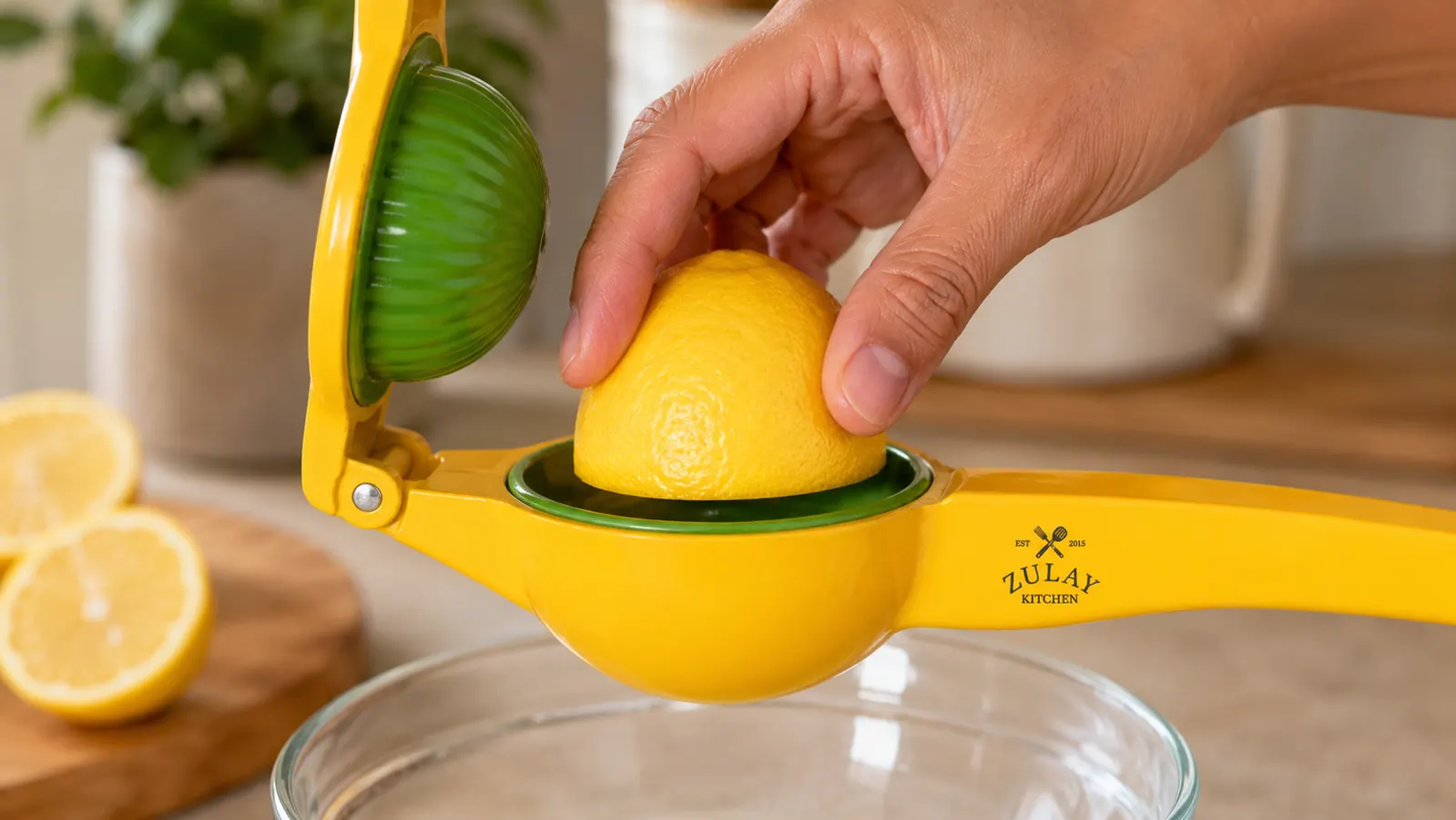
Step 2: Cut Across the Equator, Not Through the Stem
This is the step most people get backwards, and it's the one that actually determines whether a manual squeezer works well for you. Don't cut the lemon pole to pole, through the stem end and the blossom end. Cut it crosswise, through the middle, the way you'd slice a bagel in half. This exposes more of the juice-filled segments directly to the squeezer's pressure instead of running the squeeze along the membrane walls.
I didn't know this for years. I cut lemons stem to tip because that's how I'd always seen it done, probably from watching someone make lemonade as a kid. Once I switched to the crosswise cut, the difference in yield was obvious the first time, noticeably more juice from the same size lemon, and it fits into the round bowl of a hinged squeezer far more naturally too, since the cut face sits flatter against the perforations.
Use a sharp paring knife for this, not a serrated bread knife. A dull blade tears the flesh instead of slicing it cleanly, which lets more pulp and membrane clog up the works before you even start squeezing. I keep a small paring knife specifically for citrus because my chef's knife is overkill for something this size, and a clean cut face makes every step after this one easier.
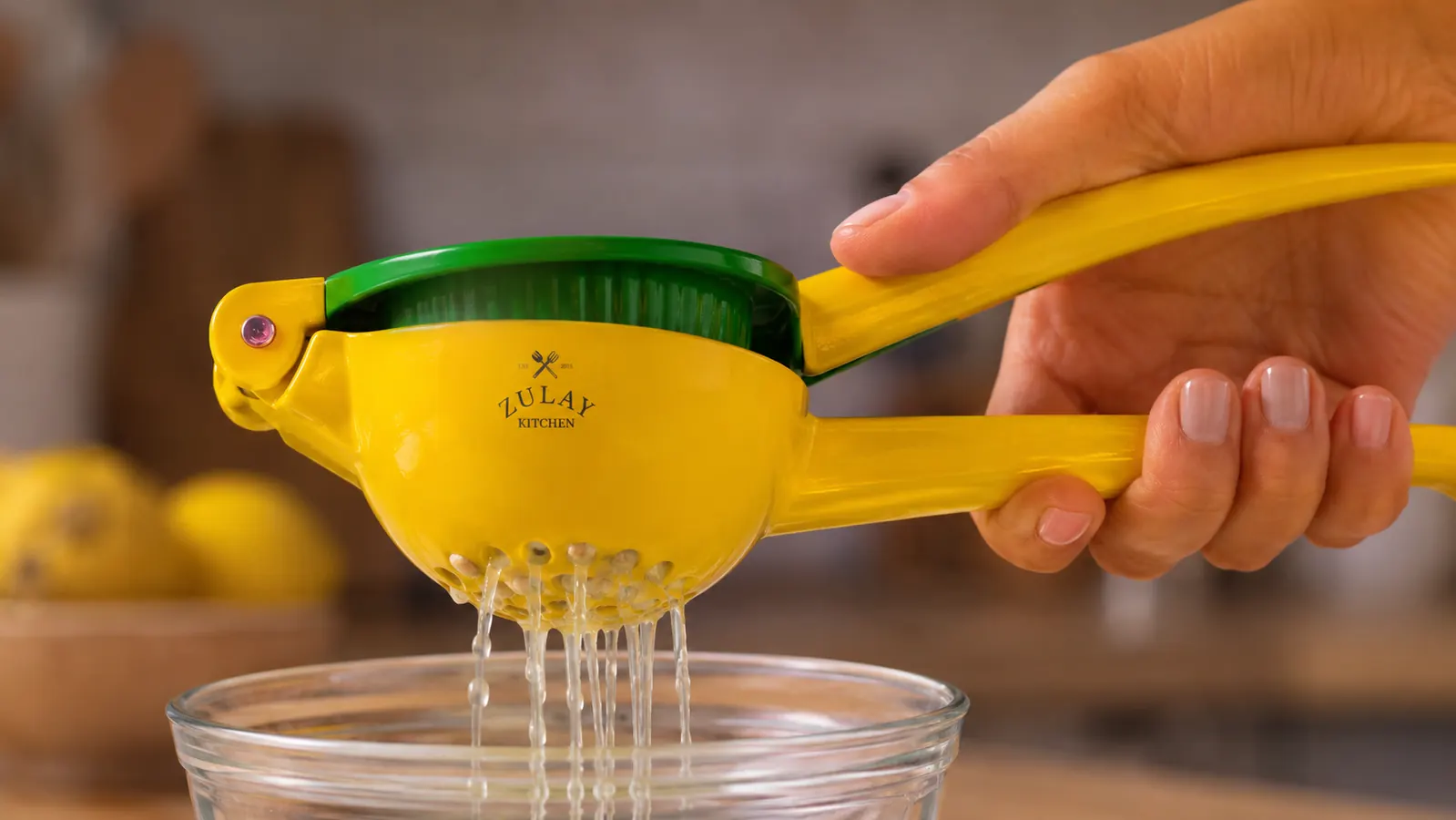
Step 3: Seat the Lemon Cut-Side Down in the Squeezer Bowl
Now the actual squeezer comes in. Open the hinged squeezer flat and set one lemon half cut-side down into the perforated bowl, rind facing up toward the handle you'll be pressing from above. This orientation matters. Cut-side down means the flesh gets pressed directly against the perforations, so juice flows straight out while the rind takes the brunt of the pressure from your hand.
If you seat it cut-side up instead, which I did by accident the first couple times, the rind ends up against the holes and you end up mashing the juicy part against the smooth metal instead of the strainer. You still get juice, but it's messier and you'll end up with more pulp splashing out the sides instead of draining cleanly into your bowl. It's a small detail, but it's the one mistake that makes people think their squeezer isn't working right.
Position your catch bowl directly under the hinge before you start squeezing, not after. I've forgotten this exact step more than once, mid-recipe, and ended up with lemon juice running down the outside of a mixing bowl I'd shoved in a second too late. A wide, shallow bowl works better than a narrow one since the juice stream isn't always perfectly centered, especially once the squeezer's a couple years old and the hinge has loosened up slightly.

Step 4: Squeeze With Steady, Even Pressure, Not One Hard Clamp
Grip both handles with one hand each, or both hands together if the lemon is on the larger side, and squeeze in one slow, steady motion rather than a single quick clamp. A hard fast squeeze can cause the lemon to slip sideways inside the bowl, and it also tends to force pulp and membrane through the holes along with the juice, which defeats part of the point.
I count to about five in my head as I press the handles together, easing off slightly, then squeezing again for a second pass. That second pass genuinely surprises people the first time they see it, there's almost always more juice left after the first squeeze than you'd expect. A full lemon typically gets me somewhere around three tablespoons of juice this way, sometimes closer to four with a good, juicy one, versus maybe two if I'm just squeezing by hand.
Watch your hand position too. The metal handles on a squeezer like this have decent leverage, so you don't need to white-knuckle it. If you're straining hard enough that your wrist hurts, you're either working with an underripe lemon or you're fighting the tool instead of letting the leverage do the work. Ease up and let the mechanism do what it's built for. My ten-year-old can operate ours without much trouble, which tells you how little actual force it needs.
Step 5: Let the Perforations Do the Seed-Catching, Then Scrape the Bowl
This is the actual answer to the seed problem. The small perforated holes in a metal squeezer bowl are sized to let juice through while trapping seeds and larger pulp chunks inside. You don't need a separate strainer, a fine mesh sieve, or a fork to pick anything out. If you've cut and seated the lemon correctly, the seeds simply stay behind in the bowl of the squeezer when you open it back up.
After squeezing, open the hinge and knock out the spent lemon half along with any trapped seeds directly into the trash or your compost bin. I usually give the inside of the bowl a quick tap against the edge of the sink to dislodge anything stuck in the perforations before juicing the next half. It takes about two seconds and keeps the holes from clogging up over multiple lemons in a row.
If you notice a little pulp made it through into your juice, that's normal and honestly fine for most recipes, vinaigrettes and marinades don't care. For something like a curd or a delicate sauce where you want it completely smooth, I'll run the collected juice through a fine mesh strainer afterward, but that's a rare extra step, not something I do for everyday cooking. This same method works for limes too, though a lime half sits a little looser in a squeezer sized for lemons, so I hold the handles slightly off-center to keep it seated while I press.
What Else Helps
Beyond the squeezer itself, a couple of small habits make the whole process faster. I zest my lemons before I cut and juice them, never after, since it's much easier to run a zester over a whole lemon than a spent, squeezed-out half. If a recipe calls for both zest and juice, always zest first. I also keep my squeezer within arm's reach of my cutting board rather than stored in a lower cabinet, because the honest truth is that if a tool takes an extra ten seconds to dig out, I skip it more often than I'd like to admit and go back to squeezing by hand.
One more habit worth mentioning, juice more than you think you need in one sitting. Fresh lemon juice keeps in the fridge for a few days in a sealed jar, and it freezes well in an ice cube tray for months. On a Sunday when I'm already making vinaigrette, I'll juice four or five extra lemons and freeze the rest in one-tablespoon cubes. It means on a busy Tuesday I'm not cutting and squeezing from scratch, I'm just popping a frozen cube into whatever I'm cooking.
Cleanup is quick too, which is part of why this tool stays out on my counter instead of getting buried in a drawer. I rinse the bowl under hot water right after use, since dried pulp is a lot harder to scrub out than fresh pulp, and mine goes through the dishwasher's top rack every week or two with no issues. Letting citrus juice sit on bare metal for days isn't great for the finish, so a quick rinse right after squeezing has kept ours looking new well past the first year.
The fix for seedy lemon juice was never a strainer. It was cutting the lemon the right direction and letting the squeezer's own holes do the job they were built for.
If you want more detail on how this specific squeezer holds up over months of regular use, I wrote a longer review after using it several times a week for months, and a shorter rundown of why it earns a permanent spot in my kitchen drawer if you want the quick version.
Five steps, zero seeds, more juice than squeezing by hand.
The Zulay Metal 2-in-1 lemon squeezer handles both lemons and limes, traps seeds automatically, and is dishwasher safe for easy cleanup. Around $15 at today's price on Amazon.
Amazon Check Today's Price on Amazon →