
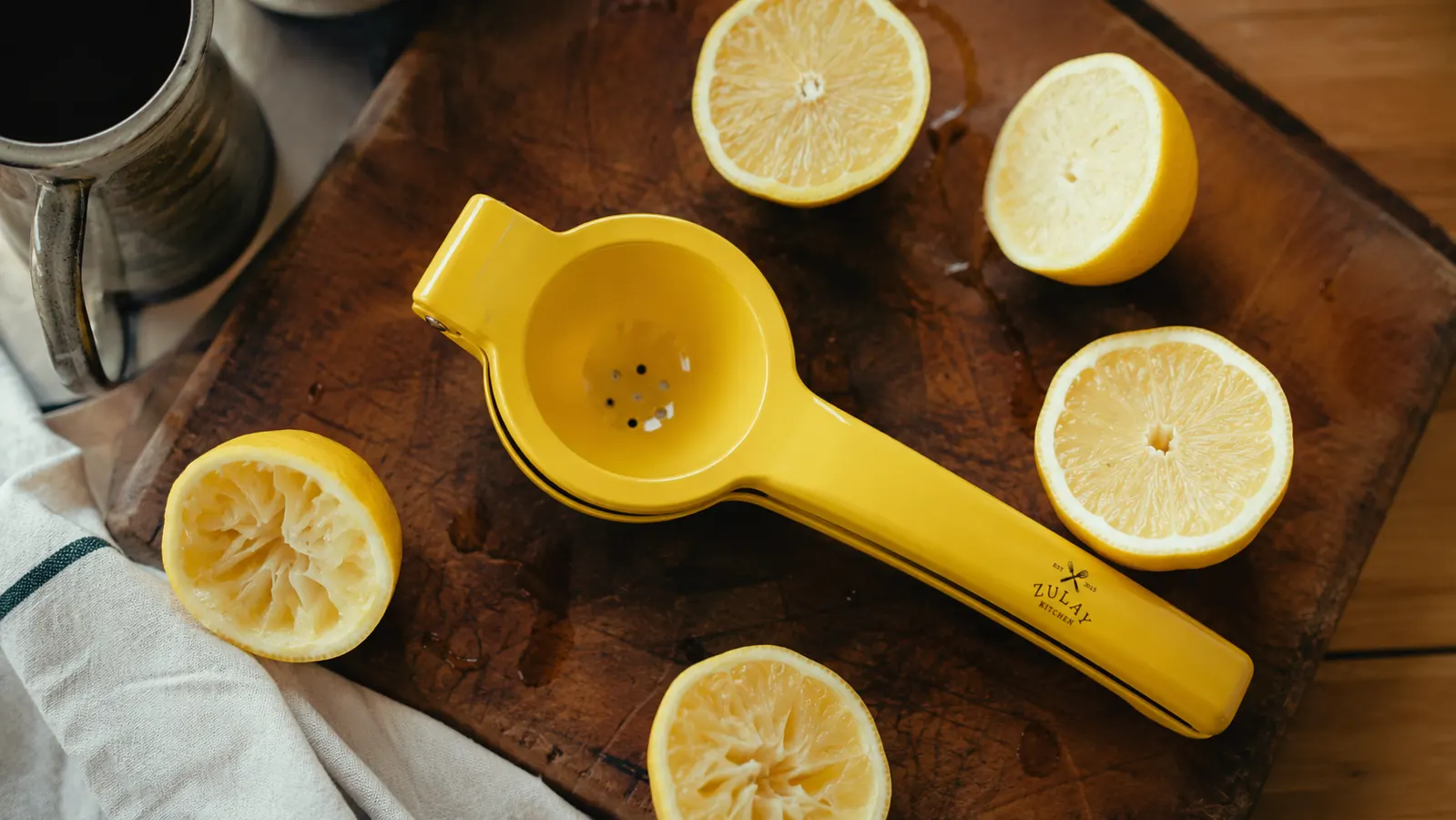
Four months ago I bought the Zulay Metal 2-in-1 Lemon Squeezer because I was tired of hunching over the sink squeezing lemons by hand, picking seeds out of my kids' lemonade with a fork afterward, and giving up on a lemon half while it still had juice left in it. I cook dinner most nights for a family of four, and citrus shows up in something almost every week, a pan sauce for chicken piccata, a vinaigrette for the salad that has to last through Wednesday, a marinade for grilled shrimp, or a round of margaritas on a Friday when the week is finally over. This squeezer has been in that rotation the entire time, sitting in the same spot next to my cutting board rather than getting shuffled to the back of a drawer the way most single-purpose gadgets do in my kitchen after the first few weeks.
I'm not going to pretend it's flawless. The yellow enamel coating has already picked up a few small chips from getting tossed in with the rest of my utensils, and it's genuinely useless on limes bigger than a golf ball unless you cut them small enough to actually fit the bowl. But for daily use on lemons, and most limes, it has earned a permanent spot on the counter next to my cutting board instead of getting buried under spatulas like most single-use gadgets do around here. Four months and roughly 170 pieces of citrus later, I still reach for it before I reach for anything else.
The Quick Verdict
A genuinely useful daily tool for lemons and small limes that catches seeds and pulp without any babysitting, though the enamel coating shows wear and it struggles with larger citrus.
Amazon Check Today's Price →Tired of picking seeds out of your lemonade with a fork?
The Zulay Metal 2-in-1 Lemon Squeezer catches seeds and pulp automatically and gets more juice out of every lemon than squeezing by hand. It's currently one of the highest-rated citrus squeezers on Amazon.
Amazon Check Today's Price on Amazon →How I've Used It
I didn't set out to review this thing scientifically. I bought it in March after a grocery store lemon sale left me with a mesh bag of nine lemons and a hand cramp from squeezing the first three over the sink. Since then it's gone through, by my rough count, somewhere around 130 lemons and another 40 or so limes. Tuesday nights are chicken piccata or a lemon garlic pasta at least twice a month in this house. Friday nights are usually margaritas or a gin and tonic with fresh lime. Sunday mornings often mean a big batch of vinaigrette to portion out for the week ahead, and every summer barbecue since May has ended with someone asking me to squeeze one more lemon for the pitcher of iced tea.
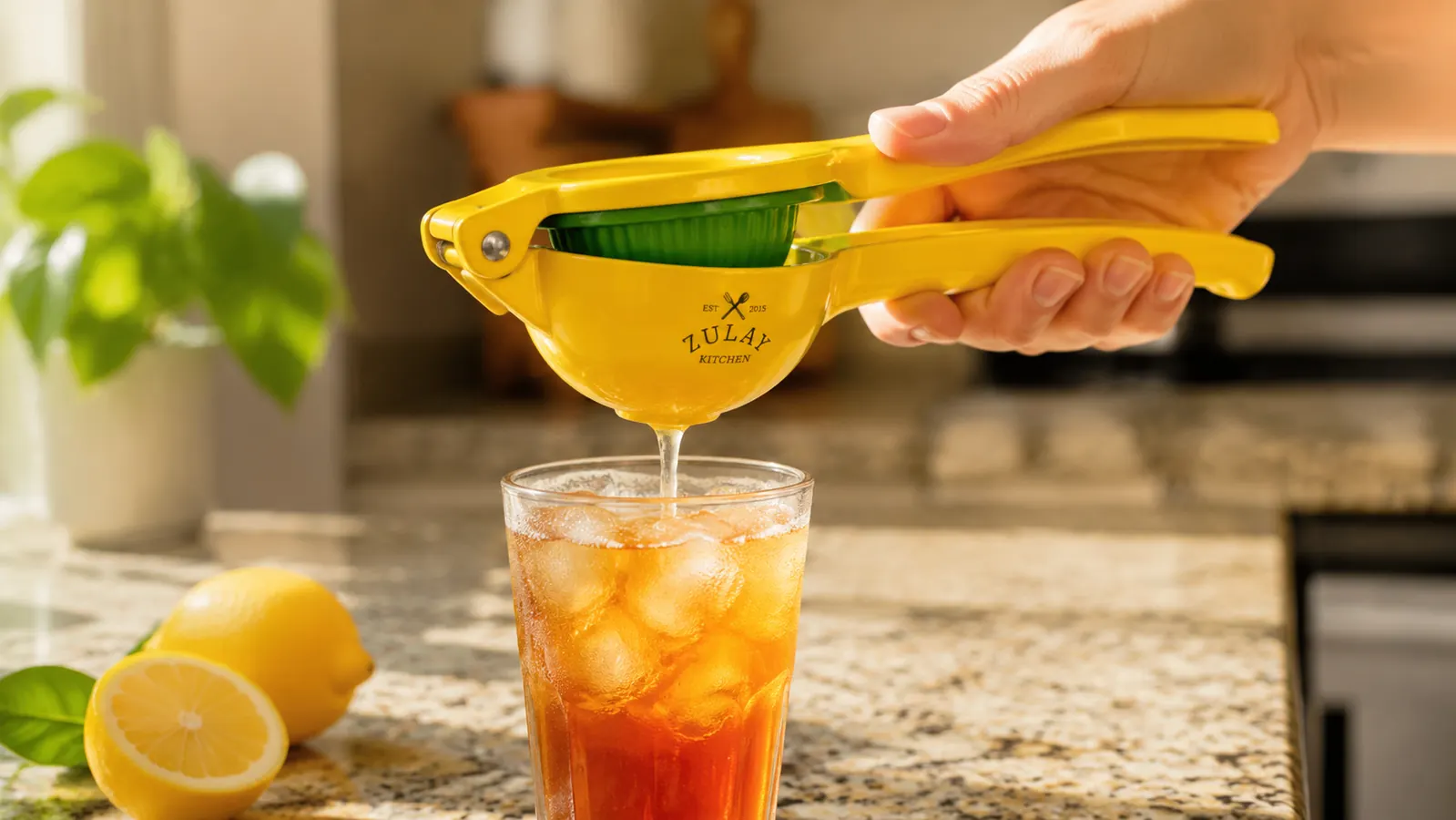
The process is always the same. Cut the lemon in half, drop a half cut-side down into the bowl, and squeeze the handles together over a glass, a bowl, or straight into a cocktail shaker. The hinge does most of the work, so squeezing feels less like gripping a stress ball and more like closing a stapler. My wrists notice the difference, especially on nights when I'm juicing six or seven lemons for a big batch of dressing, something that used to leave my hand aching by lemon number four when I was doing it by hand.
I also started leaving it out on the counter instead of putting it away after every use, which sounds like a small thing but genuinely changed how often I cooked with fresh citrus instead of reaching for the bottled lemon juice in the fridge door. When a tool is one step away instead of buried in a drawer, I use it. That's been the real, unscientific measure of whether this thing earned its keep.
Four months in, the mechanism itself hasn't loosened or squeaked. The hinge pin is still tight, the bowl still seats flush against the handle, and it still snaps open the same way it did the first week. What has changed is cosmetic, not functional, and that distinction matters when you're deciding whether a tool at today's price is worth the drawer space.
The Build: Stamped Metal, Enamel Coating, and the Handle
This is a cast aluminum body with a yellow and green enamel finish, not stainless steel, which matters for both weight and durability. It's heavier than the plastic squeezers I've owned before, enough that it sits flat on the counter instead of sliding around when I press down, but it's not so heavy that it feels like a chore to pick up and use for a single lemon. The two colors, a bright yellow bowl half and a green handle half, also make it easy to spot in a drawer full of stainless steel tools, which sounds minor until you're digging around one-handed while something's about to boil over.
The bowl has a series of small holes punched through the bottom, no separate mesh strainer to lose or wash separately. Juice and pulp pass through, seeds and larger membrane pieces stay trapped inside the bowl. The handles are long enough that I get real leverage without pinching my fingers, which was my one complaint with a cheaper plastic squeezer I owned before this one, where the handles were short enough that my knuckles occasionally scraped together on a stubborn, underripe lemon.
The enamel coating is where I have my honest gripe. After four months of daily use and regular trips through the dishwasher's top rack, there are three small chips near the hinge where the yellow paint has worn down to bare metal underneath. It's cosmetic, the tool still functions exactly the same, but if you care about how your kitchen tools look after a year of use, know that the coating isn't bulletproof. I've started hand-washing it more often than I did in month one, mostly to slow the chipping down, and it seems to have helped.
Juice Yield: Does It Still Get Every Last Drop After 130 Lemons
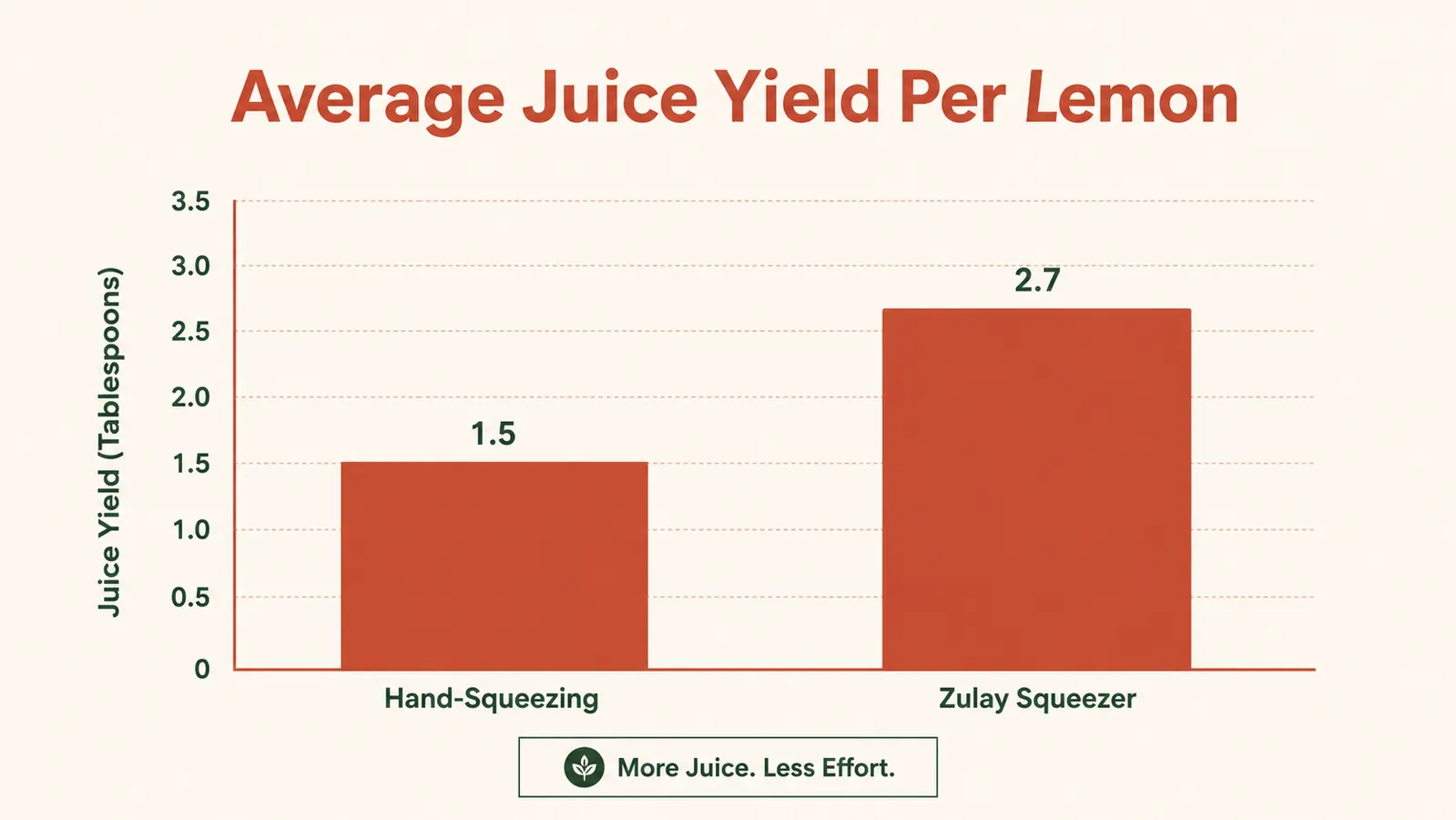
This was the actual thing I wanted to test, since 'gets every last drop' is printed right on the packaging. I ran a rough comparison early on: five lemons squeezed by hand into a measuring cup, five identical lemons from the same bag squeezed with the Zulay. Hand-squeezing averaged about 1.5 tablespoons per lemon. The squeezer averaged closer to 2.7 tablespoons per lemon, nearly double, mostly because the hinge applies even, full pressure across the whole lemon half instead of the uneven squeeze my hand manages when it's tired or the lemon is slightly underripe.
I repeated a smaller version of that test again in month three, mostly out of curiosity about whether the mechanism had lost any of its bite. The yield held steady, still noticeably more than hand-squeezing, still consistent from lemon to lemon regardless of ripeness. That's the part that actually changed my cooking, not the extra juice itself, but the fact that I stopped guessing how many lemons a recipe would actually need. A recipe that calls for a quarter cup of lemon juice used to mean grabbing five or six lemons just in case. Now I know two, sometimes three, will get me there.
Limes are a mixed story. Small to medium limes, the kind you'd get in a standard grocery bag, work exactly as well as lemons do, and I noticed a similar yield jump compared to squeezing them by hand. Larger limes, the kind sold individually near the specialty produce, often don't fit the bowl deep enough to seat properly, and I end up losing juice around the edges or just going back to cutting them into quarters and squeezing by hand the old way.
The Seed and Lime-Size Problem Nobody Warns You About
The seed-catching claim is the one that gets repeated in every glowing review, and in my experience it's mostly true, with one caveat. Standard lemon seeds get trapped in the bowl reliably, I genuinely cannot remember the last time one made it into a glass. Occasionally a smaller immature seed or a seed fragment from an overripe lemon slips through one of the drain holes, maybe once every fifteen or twenty lemons in my experience. It's rare enough that I still trust it over hand-squeezing through my fingers, but it's not a perfect zero, and I still glance at a drink before handing it to one of my kids.
The bigger practical annoyance, mentioned above but worth repeating on its own, is citrus size. This tool is sized for lemons and small to medium limes. Grapefruit, oranges, and larger limes simply do not fit the bowl. I learned this the hard way trying to juice a grapefruit for a Sunday brunch cocktail and ended up back at the manual reamer I thought I'd retired to the back of the cabinet.
There's also a small learning curve around positioning. If you drop the lemon half in slightly off-center, you get uneven pressure and a noticeably lower yield. It took me maybe five or six lemons before seating it correctly became automatic, not a big deal, but worth knowing going in so you don't judge the tool on your first attempt, which is exactly what happened to me the first time I handed it to my husband without any instructions.
Cleanup and Storage After Four Months
Cleanup has genuinely been the best part of owning this. A quick rinse under hot water clears out most of the pulp, and a run through the dishwasher's top rack handles the rest. There are no crevices deep enough to trap old juice the way some citrus tools do, and I've never noticed any lingering lemon smell days later, which happened with a plastic reamer I used to own. Compare that to hand-squeezing, which usually meant a sticky counter, a sticky measuring cup, and a sink full of seeds to fish out before they went down the drain.
Storage is simple too. It doesn't fold flat, so it takes up a bit more vertical space than a flat citrus reamer would, but I keep mine standing in a utensil crock next to my wooden spoons rather than laid in a drawer, and it's never been in the way. If drawer space is tight in your kitchen, that's worth factoring in, though for me the tradeoff of a slightly bulkier tool that I actually use beats a flatter one that sits unused.

What I Considered Instead
Before buying this, I looked at two other routes. The first was an electric citrus juicer, which I ultimately skipped because I didn't want another single-purpose countertop appliance taking up space, and because for one or two lemons at a time, plugging in a machine and washing its extra parts felt like overkill. The second was a cheaper plastic hinged squeezer, which I actually owned first and replaced after the hinge cracked around the eight-month mark from regular dishwasher cycles.
The metal build on the Zulay is the reason I upgraded, and after four months it's holding up better than the plastic version did in the same span, minus the cosmetic chipping I mentioned. If your citrus habit is occasional, a couple of lemons a month, the plastic version is probably fine and cheaper, and you likely won't put enough cycles on it to hit the failure point I ran into. If you're juicing citrus multiple times a week the way I do, the sturdier hinge on the metal version is worth paying a bit more for.
What I Liked
- Nearly doubles juice yield compared to hand-squeezing in my side-by-side test
- Catches seeds reliably, occasional small fragment slips through
- Hinge still tight and rattle-free after 130+ lemons
- Dishwasher safe, top rack, no separate mesh strainer to lose
- Long handles give real leverage without pinching fingers
- Easy, mess-free cleanup compared to hand-squeezing
Where It Falls Short
- Enamel coating chips with regular dishwasher use over months
- Doesn't fit larger limes, oranges, or grapefruit
- Needs correct centering for full yield, small learning curve
- Heavier than plastic squeezers, less ideal for small hands or limited grip strength
- Doesn't fold flat, takes up a bit more storage space
The mechanism hasn't loosened once in four months. The coating has chipped, but the thing it's actually built to do, it still does exactly as well as the day I bought it.
Who This Is For
If you cook with lemons or limes even once or twice a week, marinades, dressings, cocktails, iced tea, this earns its spot on the counter fast. It's especially worth it if hand-squeezing bothers your wrists or hands, since the hinge does the gripping work for you, and if you've ever picked a seed out of a drink after the fact, the built-in straining alone is worth the price. It's also a solid pick for anyone who mixes cocktails regularly and wants consistent, fast juice without dragging out an electric juicer for two limes.
Who Should Skip It
If your citrus use is occasional, a lemon wedge for tea now and then, this is more tool than you need, and a basic wooden reamer will do the job for less money and less drawer space. It's also not the right pick if grapefruit and large limes are a regular part of your kitchen, since the bowl simply won't accommodate them, and you'll end up needing a second tool anyway. And if a scuffed, chipped finish after months of use is going to bother you, know that going in.
130 lemons in, the hinge still hasn't loosened once.
At today's price, the Zulay Metal 2-in-1 Lemon Squeezer has replaced hand-squeezing in my kitchen for good. If citrus shows up in your weekly cooking, it pays for itself the first week.
Amazon Check Today's Price on Amazon →