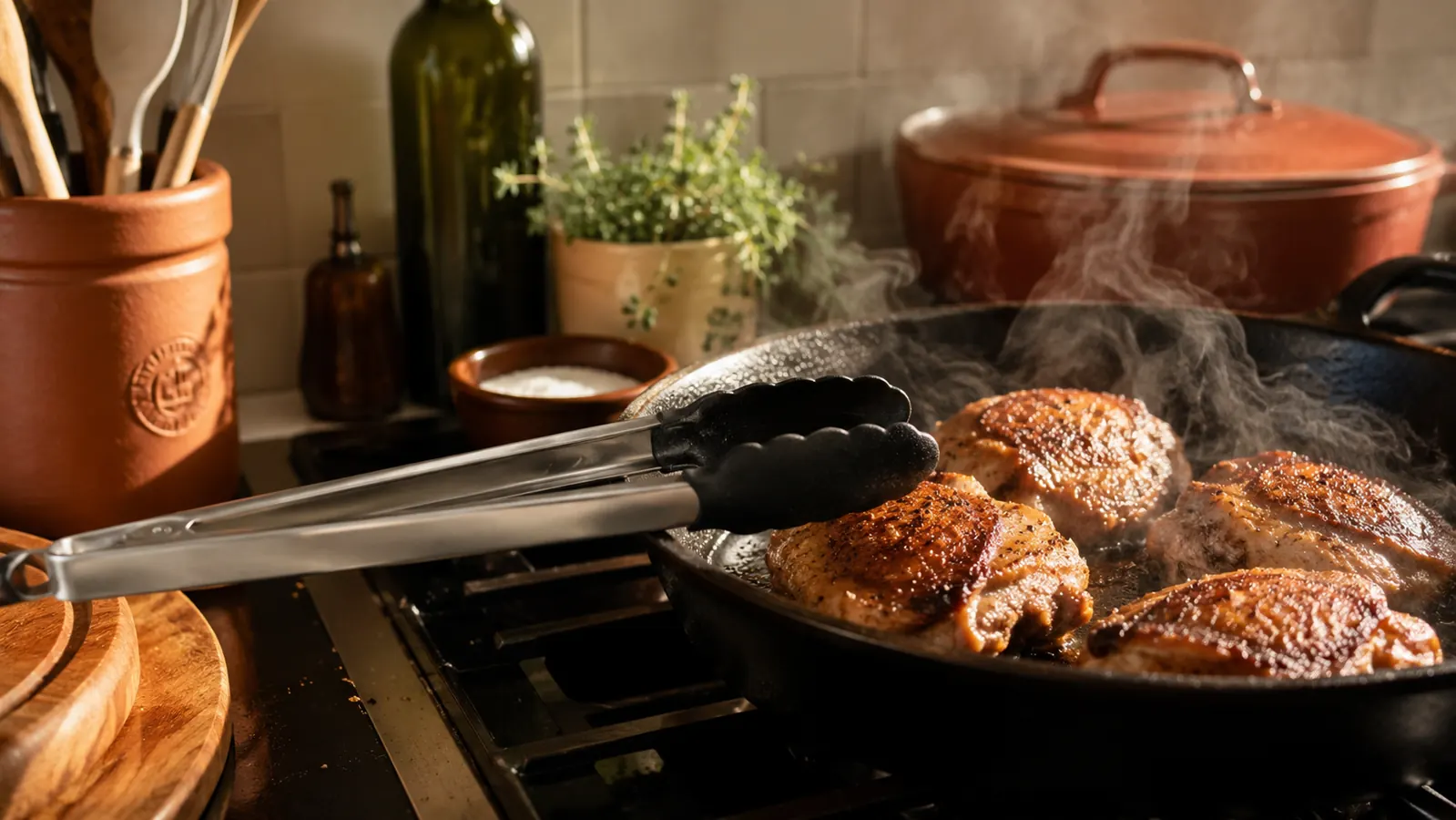
I bought the HOTEC locking tongs in January mostly to round out a $35 Amazon order and get free shipping. Nine dollars and ninety-nine cents for a set of two, a 9-inch and a 12-inch, stainless steel with silicone tips so they wouldn't scratch my nonstick pans. I figured they'd replace the warped plastic tongs that had been melting slowly against my stovetop for two years, and that would be the end of the story. It is July now, and I would guess these tongs have touched close to 500 dinners in my kitchen since then. Searing chicken thighs, flipping bacon, tossing pasta, turning corn on the cob at three different cookouts, pulling a whole roasted chicken out of a hot pan without dropping it on the floor. They live in the crock next to my stove, not in a drawer, because I reach for them more than I reach for my favorite chef's knife most nights.
So here's the long-term verdict, not the week-one unboxing kind of review, but the one after six months of actual daily use, one trip through the dishwasher too many, and a spring lock mechanism that's been engaged and released probably a thousand times at this point.
The Quick Verdict
A genuinely excellent everyday tool that grips better than any tongs I've owned before and locks flat for storage, but the smaller 9-inch pair has developed a slight wobble at the hinge that the 12-inch pair doesn't have.
Amazon Check Today's Price →Still fighting a spatula and a fork to flip dinner?
These are the exact locking tongs I've used almost every night since January. Silicone tips grip without scratching, and the whole set locks flat for a drawer that doesn't fight you every time you open it. Currently under $10 for both sizes.
Amazon Check Today's Price on Amazon →How I've Used Them
My weeknight routine is unglamorous, which is exactly why these got tested so hard. Most nights I'm searing some kind of protein, chicken thighs, pork chops, salmon fillets, in a cast iron or stainless pan, and the 12-inch tongs are what flip it. The extra length keeps my knuckles a safe distance from spattering oil, something my old 8-inch plastic tongs never managed. The 9-inch pair mostly lives near the stove for smaller jobs, turning bacon, tossing a quick saute of green beans, plating pasta straight out of the pot without dragging half of it onto the counter.
I've also used them for things that have nothing to do with a stovetop. Grabbing toast out of the toaster oven when I don't want to touch the hot rack. Pulling jars out of a boiling water bath the two times I've done small-batch canning this year. Turning corn on the cob over a charcoal grill at my brother-in-law's Fourth of July cookout, where three other people asked where I got them before the night was over. My husband Mark has even started grabbing the 12-inch pair for flipping burgers on our little balcony grill, which is the closest thing he's got to a signature kitchen tool, so that alone told me these had earned a permanent spot in the house.
What actually changed my behavior is the locking mechanism. My old tongs never locked, so they lived loose in a drawer, tangled with a whisk and two spatulas every single time I reached in for something else. These squeeze the handles together, slide the little tab down, and lock completely flat. They stand up in the utensil crock without splaying open, and they don't catch on anything else in the drawer when I do put them away. That's a small thing, but it's the kind of small thing that decides whether a tool actually gets used daily or ends up buried under the can opener.
The Locking Mechanism and Silicone Tips: What's Actually Good Design Here
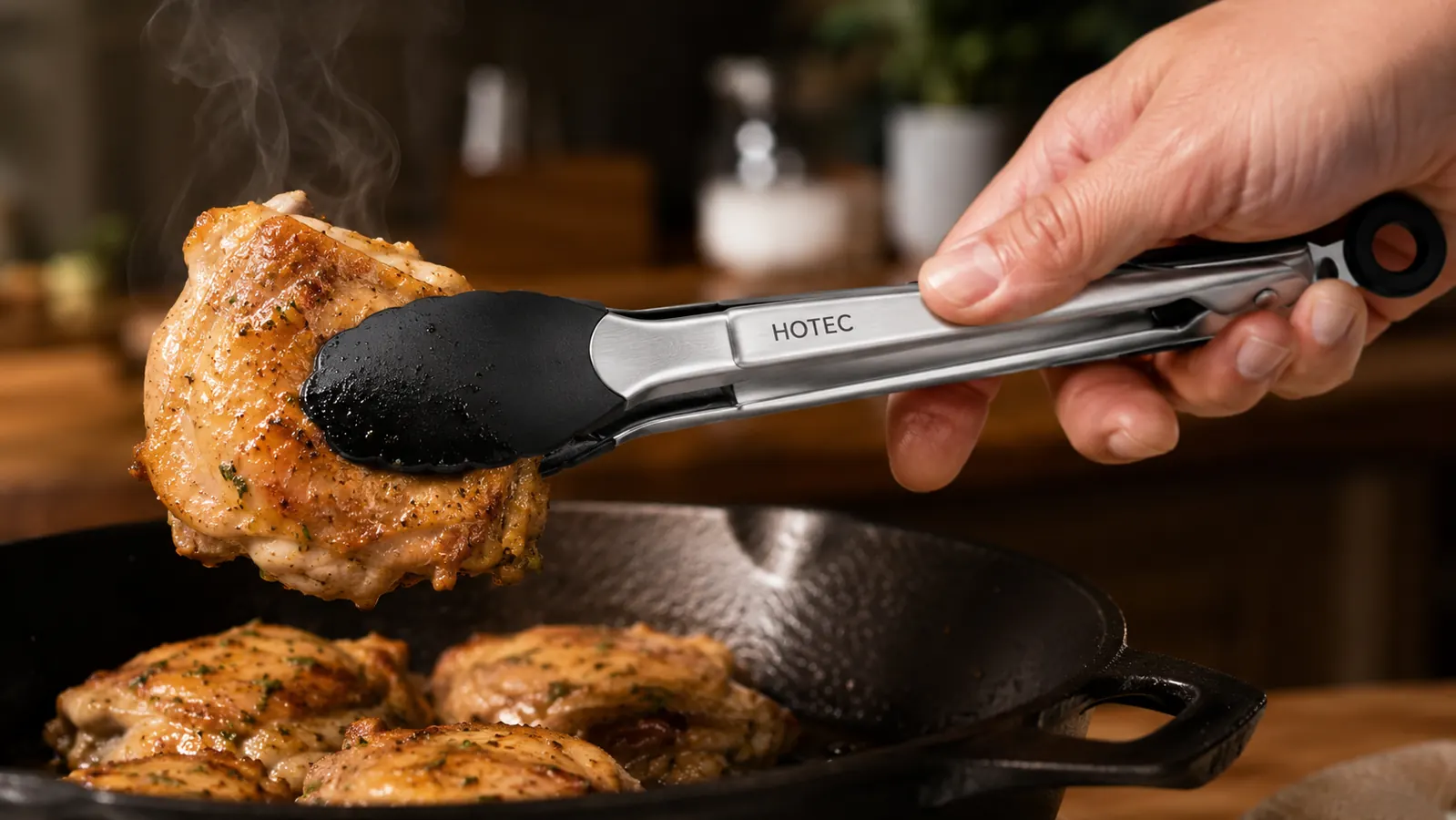
The tongs are one-piece stainless steel construction with a scalloped edge at the tip, and silicone caps that snap over the metal jaws. The scalloped stainless underneath gives real grip strength, which matters when you're trying to lift a whole chicken breast without it slipping back into the pan, and the silicone tips mean I can use them directly in my nonstick skillets without worrying about scratches the way I would with bare metal tongs.
The locking tab is the part I was skeptical about before buying, because I've owned locking tongs before where the tab either doesn't hold under any pressure or locks so tightly you need two hands to release it one-handed while your other hand is holding a hot pan lid. This one slides with a light thumb push and holds firm through vigorous tossing, which I tested more or less by accident the first time I used them for a big stir-fry and forgot they weren't locked, they stayed shut through a solid minute of tossing vegetables around a wok.
The scalloped tip design is honestly the detail that sold me on daily use. Instead of the flat-faced grip on my old tongs, which let a slippery pork chop slide right back out if I wasn't careful, the curved teeth on these bite into whatever I'm holding just enough to keep control without piercing the meat and losing juices. For something as basic as flipping dinner, that difference in control has genuinely made me a slightly better cook, or at least a less anxious one at the stove.
Six Months In: Do They Still Grip Like Day One?
This is the part most tong reviews skip, because most reviews get written the week the product shows up. Here's what six months of near-daily use actually did to them. The 12-inch pair still grips exactly like it did in January. No wobble, no loosening at the rivet, silicone tips still fully attached and showing only light surface scuffing from the cast iron. If I hadn't used them myself I'd assume they were brand new.
The 9-inch pair is a different story, and it's the one real ding I have against this set. Around month four I noticed a slight side-to-side wobble at the hinge rivet, just enough that the tips don't line up perfectly flush anymore when I close them. They still function fine, they still grip, but there's a small gap where there used to be a clean seal. I checked with a friend who bought the same set two months after me, and hers doesn't have the wobble yet, so it might just be that the smaller pair sees more repetitive small-motion use in my kitchen, more quick grabs and releases rather than sustained holds.
The one real mistake I made was running both pairs through a hot dishwasher cycle on the top rack for the first month before I actually read the care instructions on the packaging. Nothing warped, and the silicone held its shape fine, but I switched to hand-washing them after that just to be safe, since repeated high heat cycles are usually where silicone tips start to degrade or discolor over time, and I'd rather not find out the hard way with a tool I use every single day. I also keep the stainless jaws away from the disposal side of my sink now, after one close call with the garbage disposal switch that made me realize how easily a dropped utensil could end up somewhere I didn't want it.
Where They Fall Short
I want to be straight about this because a lot of tongs listings make it sound like buying a $10 pair of tongs is a life-changing purchase, and it mostly isn't. The 9-inch pair's hinge wobble is a real flaw, even if it hasn't affected function yet, and I'll be watching it over the next few months to see if it gets worse. If it does, I'll probably replace just that one and keep the 12-inch pair going, since that's the one I actually reach for most.
The locking mechanism, while good, isn't instant. There's a learning curve of maybe two or three uses before your thumb finds the tab reliably without looking, and until then you might fumble it once or twice trying to unlock them one-handed while something's actively cooking. Not a dealbreaker, but worth knowing going in.
And they're not great for anything requiring real delicacy. I tried using the 9-inch pair to plate a piece of pan-seared fish once, and the scalloped teeth that grip a chicken thigh so well left visible marks on the flaky fish skin. For delicate proteins I still reach for a fish spatula. These are built for grip and control on sturdier food, not for gentle plating.
The Two-Size Set: Why Both Get Used
I was skeptical a two-pack was necessary before I owned these, figuring I'd use the bigger one and let the smaller one sit in a drawer. That's not how it worked out. The 12-inch handles almost everything at the stove, the reach it gives you matters when you're standing over a hot pan of bacon grease or turning something on a hot grill grate. But the 9-inch is what I actually keep closest, the one for quick tosses in a smaller saute pan, for plating, for grabbing toast, for anything where the extra three inches of the bigger pair just gets in the way.
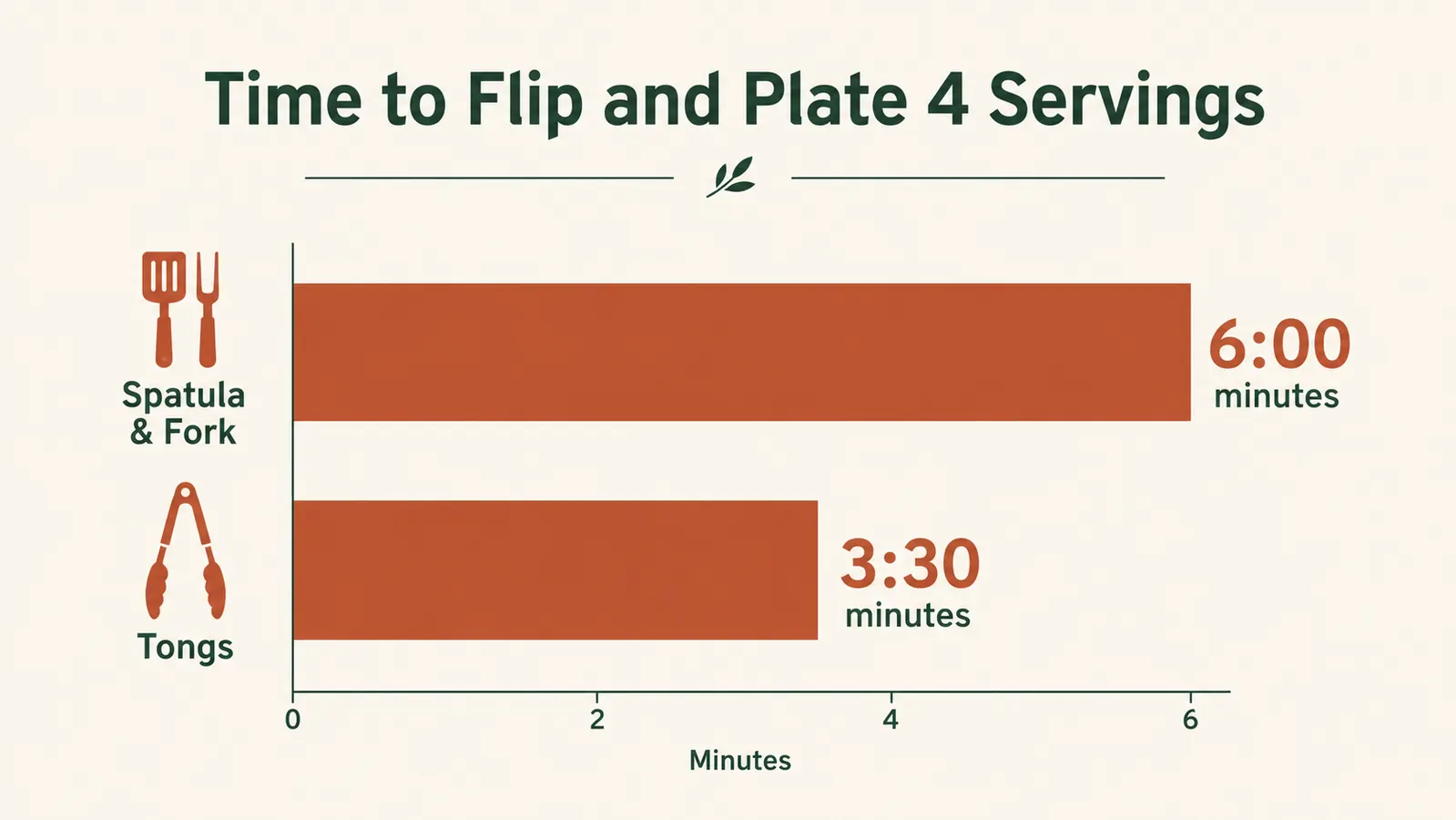
I timed myself flipping and plating a simple four-serving stovetop dinner, chicken thighs and green beans, one night using my old spatula-and-fork combination, then again a few nights later using the tongs for both jobs. The spatula-and-fork method took just under six minutes once you count switching tools between the pan and the plate. The tongs handled both jobs without a tool swap and took closer to three and a half minutes, mostly because there's no fumbling for a second utensil mid-cook.
Other Tongs I Considered First
Before landing on the HOTEC set, I looked at two other options in my cart. One was a single 12-inch all-metal pair with no silicone at all, sold as a professional-style tong. I passed on it because I already have a couple of nonstick pans in regular rotation, and bare metal tongs on nonstick coating felt like a bad long-term bet even if the tongs themselves would probably outlast me. The other was a cheaper three-pack that included a 7-inch, a 9-inch, and a 12-inch, priced only a couple dollars less than this two-pack. I skipped it mostly on reviews, several buyers mentioned the smallest size in that set felt flimsy and the silicone peeled within weeks, which is exactly the kind of long-term failure I was trying to avoid after years of cheap plastic tongs melting on my stove.
Looking back after six months, I think the two-size approach was the right call for how I actually cook. A third, smaller size would mostly have sat unused in my kitchen, and the extra couple of dollars I would have spent on the three-pack wouldn't have bought me anything I needed. The 9-inch and 12-inch combination covers essentially every stovetop and grill task that comes up in a normal week, and I haven't once wished I had a different length on hand.
What I Liked
- Scalloped stainless tips grip slippery food far better than a spatula or fork
- Locking mechanism holds flat for tangle-free drawer or crock storage
- Silicone tips protect nonstick cookware without sacrificing grip strength
- 12-inch length keeps hands a safe distance from stovetop spatter
- Two-pack covers both big stovetop jobs and delicate plating tasks
- Priced under $10 for both sizes together
Where It Falls Short
- 9-inch pair developed a slight hinge wobble after about four months of daily use
- Locking tab takes a couple uses to find reliably one-handed
- Scalloped teeth leave visible marks on delicate foods like flaky fish
- Not fully proven for repeated high-heat dishwasher cycles, better hand-washed
The HOTEC tongs aren't a miracle gadget. They're just the tool I now reach for before I even decide what I'm cooking.
Who This Is For
If you're still flipping proteins with a fork and spatula combo, or your current tongs live loose and tangled in a drawer, this set earns its spot within the first week. It's especially worth it if you cook with cast iron or stainless steel regularly, since the grip strength on the scalloped tips genuinely outperforms anything with a flat plastic head. Anyone who cooks most weeknights and wants one tool that handles searing, tossing, and plating without a drawer full of backups will get real daily use out of these.
Who Should Skip It
If you mostly cook delicate foods, fish fillets, eggs, anything that needs a gentle touch rather than a firm grip, a good fish spatula will serve you better than tongs ever will. And if you're someone who runs everything through a hot dishwasher without a second thought, know that these do best with occasional hand-washing, so if that's not realistic for your routine, a cheaper all-metal pair without silicone tips might hold up more predictably long term.
Five hundred dinners in, these are still the first thing I grab.
If you're tired of fighting a spatula and fork every time you flip dinner, this locking two-pack earns its spot at the stove fast. Grab it before your next grocery run.
Amazon Check Today's Price on Amazon →